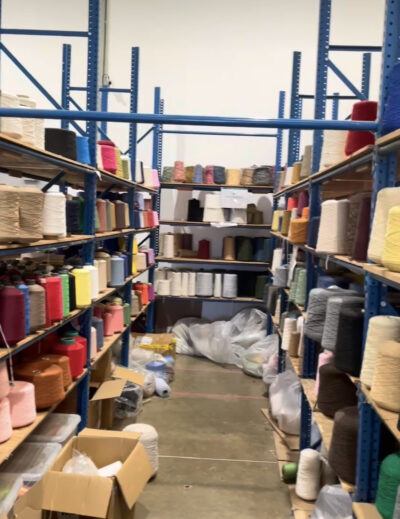
Yeoman Yarns is having a BIG yarn sale! There are shelves of yarn that need to be sold and we’re invited to join them on Tuesday 6th October from 8.30am to 4.00pm.All yarn is £5 per kilo and the address is BHM, Marlborough Drive, Fleckney, Leicester LE8 8UR.
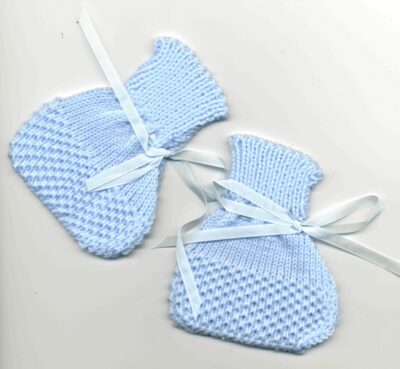
I’ve had your magazine more years than I can remember. Now my children have grown up, are having babies of their own and a new little boy is coming along this year. I remember knitting baby bootees that stayed on, looked good and were ever so quick and easy. I can’t be alone in happily knitting for a new generation. Thank you very much, Emily
BOOTEES
Yarn Any suitable 3-ply.
Machine Brother KH860 with a ribber.
To knit With carriage at right, cast on 41-0-40 sts in 1×1 rib and Tension 0/0. Work zigzag row, insert comb and small weights. Work 1 circular row. Cancel circular. Change to Tension 2/2 and K 1 row to right. Set RC at 000. K 12 rows. Transfer ribber sts to main bed. Change to Tension 5 and K 2 rows. Make a row of holes for ribbon by transferring every alt st to adjacent N. Leave empty Ns in WP. K 2 rows. Inc 1 st at beg of next 11 rows. Carriage on left. Insert Card 1 and lock. Programme machine to read card (KC button on KH860 machine). K 1 row to right. Set card to elongate, left tuck button in, release card and K 15 rows. (You could just work 15 rows in st st.) Dec 1 st at beg of next 8 rows. Cancel patterning (KC button to NL). K 1 row and cast off. Join seam. Thread ribbon and anchor it with a few sewing stitches at centre back, so ribbon can’t come out.
Could you please let us have an easy pattern for an adult balaclava. Most of my back issues are in the loft and I never venture up there in the winter. We live by the sea and it’s the only way I know to shield a man’s face from some of the biting wind. Thanks in advance, Nancy
Here’s a pattern for small, medium and large sizes, Nancy. Use any suitable 4-ply yarn with Tension Dial 7 and 3/3 for the 1×1 rib to give a firm fabric, about 30 stitches and 42 rows to 10 cm.
To knit Cast on 108 [118, 126] sts and K 40 rows 1×1 rib or 80 rows for mock rib. K 2 rows st st. Put 12 sts at each end (*) onto WY or a safety pin. K 60 rows st st. Put 30 sts (**) at each end onto WY or a stitch-holder. K 60 rows (***) st st. Using WY, K a few rows and release from machine.
To make up Refer to the diagram and join A to B by grafting 30 sts (**) onto 60 rows (***). Knit a band to go round the face by casting on 100 sts for all sizes and K 10 rows 1×1 rib or 20 rows for mock rib. Join 12 sts on each side (*) to edges of band, then join neckband at front and sew in ends.
I’m thoroughly ashamed of myself for forgetting one vital thing when knitting for charity. I work as a volunteer in a soup kitchen and at this time of year, there’s many of us on duty to help, so I decided to knit some old-fashioned but useful pot holders for picking up warm items. As oven gloves were in short supply, one of the cooks used two of my pot holders to lift a large metal pan from the stove. I’d headed for my stash and not taken sufficient care. I’d knitted most of them in wool, but some man-made yarn had crept into the mix. The man-made yarn immediately melted onto the pan. Her quick thinking and actions meant she only suffered slight burns to her hands, but I was absolutely terrified. Please, please print this warning to others. Only use pure wool for pot holders or anything going to war zones, where there will be fire and intense heat. I’ll give you my name, but would you kindly not print it and thank you for spreading the word.
These days, we can find lots of details on line for burn tests for different fibres. In a nutshell, animal fibres such as wool don’t ignite easily, smell like burning hair and leave ash we can crush easily. Man-made fibres melt, smell acrid and form hard plastic beads. Cotton burns quickly, smells like burnt paper or wood and leaves fine, light ash.
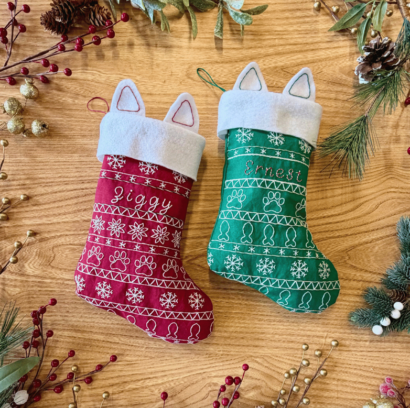
We had a discussion at the club about the new-look Dear Anne and overall we’re pleased. It’s hard to find somewhere for snippets of information, when you don’t want page after page to plough through. It’s reminded us it’s a bit like Beryl Jarvis’ Info Sheets and we have a request for you. Please can you find the pattern of some very useful slippers you published back in the mists of time. We’ve all made them at the club, but none of us can remember the pattern, especially where the folds go. They were knitted on a chunky machine and great for using up oddments. They pack flat and we highly recommend them as a great stash-buster, that are also very practical. Here’s hoping and best wishes from all of us, Ruth
It took a bit of searching, Ruth, but we’ve found them and also included some hand knitting instructions. It’s such a simple pattern, you can sit by the fire in the evening and make them in next-to-no-time.
Machine knit version
MATERIALSUse three ends of any DK or five ends of any 4-ply and the finished weight is no more than 100 grams. Version A Small amount in Dark Brown (MC) and Pink (C). Version B Small amount in Dark Brown (MC), Mustard (A), Pink (B), Green (C), Wine (D), Cream (E) and mixture of B, C and E tog (F).
SIZES & TENSIONSize 3-4 13 sts and 22 rows to 7.5cm, 3in over garter stitch at Tension 6. Size 5-6 13 sts and 22 rows to 8cm, 3¼in over garter stitch at Tension 7. Size 7-8 13 sts and 22 rows to 9cm, 3½in over garter stitch at Tension 8.
GARTER STITCH K 2 rows. Drop every stitch one row down and reform. These 2 rows form the pattern.
VERSION ALeft slipper With carriage at right and using MC, cast on 13 sts by hand. Set RC at 000. Using MT, cont in garter st. K 22 rows. Carriage is at right. Cast on 13 sts at right edge. 26 sts. K 44 rows. Carriage is at right. Using a length of MC, cast off 13 sts at left. 13 sts. Using C, K 22 rows. RC shows 88. Cast off. Right slipper Work as for left slipper, reversing shaping by reading left for right and right for left. Making up Lay left slipper down as Diagram 1 (right side is uppermost) and reverse for right slipper. Fold left slipper as shown in Diagram 2 and reverse for right slipper. Oversew seams on wrong side as indicated on Diagram 2 and reverse for right slipper. Turn to right side, push into shape and decorate.
VERSION BLeft slipper First strip With carriage at right and using MC, cast on 13 sts by hand. Set RC at 000. Using MT, cont in garter st. K 22 rows. Using A, K 22 rows. Using B, K 22 rows. RC shows 66. Cast off. Second strip With carriage at right and using C, cast on 13 sts by hand. Set RC at 000. Using MT, cont in garter st. K 22 rows. Using D, K 22 rows. Using F, K 22 rows. RC shows 66. Cast off. Right slipper Work as for left slipper. Making up Lay first and second strips of left slipper down as Diagram 3 (wrong side is uppermost) and reverse for right slipper. Oversew seam on wrong side as on Diagram 3 and reverse for right slipper. Turnover as Diagram 4 (right side is uppermost) and reverse for right slipper. Fold left slipper as shown in Diagram 2 and reverse for right slipper. Oversew seams on wrong side as on Diagram 2 and reverse for right slipper. Turn to right side, push into shape and decorate.
VARIATIONSVersion A Knit first 44 rows in MC and last 44 rows in C. +Version BFirst strip Knit 44 rows in MC and 22 rows in C. Second strip Knit 22 rows in C and 44 rows in MC.
Hand knit version
You can make these slippers quickly and easily by hand. If you’ve a young grandchild who knits, they’re ideal to make as a gift. They’re knitted in garter stitch on big needles and you can help with the size of needle. You need a pair of 5 mm or 5¼ mm knitting needles and the materials are the same as the machine knitted version. The size of needle and tightness of knitting will determine the size of the finished slipper, so first knit a tension square.
Tension square Using three strands of DK or five strands of 4-ply yarn, cast on 13 sts. Slip the first stitch of every row and garter stitch (every row knit) for 22 rows. Aim at a square with 8.25cm, 3¼in sides to fit an average foot with shoe size 5 to 6. If the finished square measures 7.5cm, 3 in, the slipper will fit shoe sizes 3 to 4. If the finished square measures 9cm, 3½in, the slipper will fit shoe sizes 7 to 8.
TO KNIT Cast on 13 sts and work 22 rows garter stitch (every row knit). Cast on 13 sts, then work 44 rows across these 26 sts. Cast off 13 sts and work 22 rows on remaining 13 sts. Cast off. If a definite right and left slipper is required, 23 rows for the first square makes the 13 stitch cast on at the opposite edge.
ALTERNATIVE METHOD Cast on 13 sts and work 66 rows, changing colour three times. Make two strips for each slipper. Fold as shown in the diagram and stitch the oversewing from the inside. Turn right side out and push into shape.
Hobbycraft is inviting customers to discover the possibilities of Cricut with a series of free in-store demonstrations across every Hobbycraft store nationwide to Sunday 18th October.
Hosted by Cricut Ambassadors, the daily drop-in sessions run from 11.30am to 3.30pm. Customers will get to see Cricut’s new machines in action, including live demonstration of the newly launched Cricut Maker™ 5. They can also test out their skills by making a free wooden bookmark using iron-on vinyl or Infusible Ink. All materials are supplied on the day. Selected stores will also feature live demos of the new Cricut AutoPress™ 2 (15″x15″).
What is Cricut? Designed for complete beginners and seasoned creators alike, Cricut is a smart cutting and crafting tool that makes learning a new skill simple. Using a smart machine paired with easy design software, Cricut precisely cuts, draws, engraves and foils hundreds of everyday materials from paper and vinyl through to fabric, wood and leather. It allows anyone to bring personalised projects to life in minutes, whether you’re labelling home pantry jars, customising T-shirts and tote bags, creating bespoke party decorations or crafting unique gifts, home decor and fashion accessories.
As the fifth heatwave of the year blazed outside, the temperature in my office equalled it as I beavered away to finish my fourth magazine in two months. I’m very pleased that I’ve finally caught up and we’re back on track again.
We’re reaching the time of year when we need to look for warmer things to wear. In today’s economic climate most of us are taking care, so head for King Cole’s website and search free patterns for an easy wrist-warmer design. It’s ideal for the LK150 and easily converted for standard gauge models. You’ll need about 100g of DK weight from your stash. After casting on 50 stitches, there are 10 rows of garter stitch to cover the base of the fingers, then 10cm of stocking stitch and 28 rows of 2×2 rib for the cuff. You can adjust it (of course!) for the length you need. Join the seam for 4cm from the garter stitch end, leave a 5cm gap for the thumb then sew the rest of the seam. For standard gauge machines you’ll need 4-ply oddments and 64 stitches (50 x the conversion factor of 1.27 = 63.5). There’s a selection of free patterns for knitting, crochet and macramé, so check it out at kingcole.com
As you’ll read on Page 50, Barbara Faulkner has died peacefully at home with her husband Derek, just shortly before the wildfires swept through Stourbridge. Those fires we all heard about were at end of their road and they were all living on a knife-edge for 24 hours. Whilst Derek’s house fortunately escaped, 37 were destroyed or damaged. Surrounded by all the devastation whilst mourning his wife’s passing, it’s hard to imagine the thoughts going through Derek’s mind. You have our love and support, Derek, as we send our sincere condolences to you, Richard and Stephen, along with all your family and many friends. Rest in peace, Barbara; you were deeply appreciated, highly valued and one of machine-knitting’s precious, wonderful designers.
NEXT ISSUEDecember 2026
Subscription copies sent out Thursday 1st October
On sale Thursday 8th October
Ask your newsagent to reserve a copy or order a subscription NOW!
Our October 2026 cover design uses all the needles on the machine for a great size range, to add another layer as the seasons change. It’s in our monthly mix of patterns for standard, mid-gauge and chunky machines. Alison Dupernex is a constant support and Bill King reminds us that machine knitting is actually easier with fewer choices! Susan Guagliumi’s expertise lives on in the Machine Knit Community and look out for Susan’s new book, on sale soon. Our newest contributor, Lidia Higson, is Chairman of Lichfield MKC (lichfieldmachineknitting.co.uk) and she helps us to start knitting again after a break. Joan Lafferty shares some fond memories (and a few giggles!) this time. We get ready for Hallowe’en with Iris Rowe’s Frankenstein and some best-buys, as the spooky season approaches. We’ve great Passap advice and after-care help from readers and our 64 colour pages are packed with techniques and help, advice, news and reviews.
Please note At present, we can only send back issues to UK mainland addresses. Otherwise, please buy the high-quality downloadable version that’s available worldwide.
NEW SUBSCRIPTIONS Our October issue was mailed to subscribers on Thursday 3rd September. If you’d like a new hard copy subscription, as long as we receive your order by or on 1st October, it will start with our November magazine.
INTERNATIONAL SUBSCRIPTIONS We’re sorry that we’re unable to send hard copy back issues outside the UK mainland, so please buy a downloadable version in the shop.
UK SUBSCRIPTIONS If you’d like to start with an earlier magazine, please buy it as a back issue and you’ll find lots of choice in our shop. UK readers please note At present, we can only send back issues to UK mainland addresses.
NEW DIGITAL VERSION From the January 2023 issue, you can now buy the digital version of the magazine. Just head for the SHOP and select either the hardcopy or downloadable option. The downloadable magazine is just £4 (sterling) for each issue and available straight away. It saves the huge expense and wait for overseas postage, so check it out NOW at machineknittingmonthly.net/shop/Please note that, as yet, we don’t have a digital subscription available.
Our September 2026 cover design, in a large size range, is great for wearing at any time of the year. It’s in our mix of patterns for standard, mid-gauge and chunky machines including two Anne Baker Karabee designs. Nina Miklin’s timeless classic is a man’s cardigan with a superb look and fit. Alison Dupernexis a constant support and Bill King has our very basic machines punching above their weight. With two needle beds that only knit or slip all needles, he has us knitting Jacquard! Lidia Higson begins a series of basic techniques and shares her methods of knitting cables. Joan Lafferty has to keep calm and carry on knitting, as we look at a new book… the Machine Knitter’s Reference: A blueprint for improving your knitting. As always, the magazine is packed with techniques and help, advice, news and reviews.
Please note At present, we can only send back issues to UK mainland addresses.